
What 500+ Conversations With CRE Firms Taught Me About AI Adoption

Over the past couple of years, I’ve had more than 500 conversations with commercial real estate firms about AI.
Some are large institutional investors. Others are developers, lenders, brokerages, operators, and smaller entrepreneurial shops. The people I speak with range from CEOs and CIOs to analysts who started using ChatGPT before anyone at the firm had decided whether they were allowed to.
Across those conversations, one pattern has become pretty clear.
Most commercial real estate firms no longer need to be convinced that AI matters.
Many are already paying for ChatGPT, Claude, Copilot, or some other AI tool. Their employees are experimenting with them. A few power users have gone deep. Leadership is asking questions. Budgets are starting to move.
And yet, actual AI adoption in commercial real estate remains surprisingly shallow.
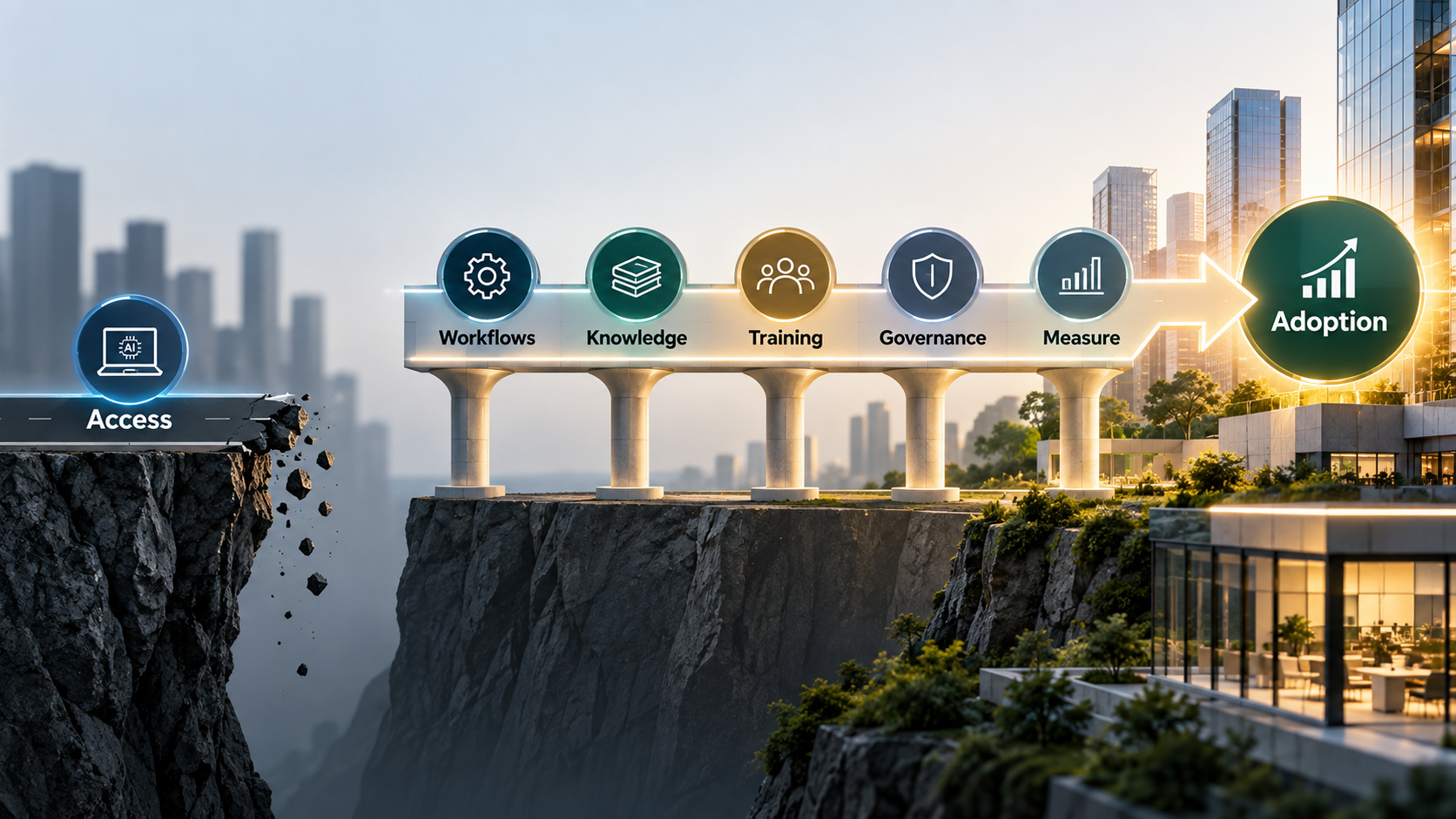
The hard part is no longer getting access to AI. The hard part is changing how a firm works because AI exists.
Start With the Work
One of the most common mistakes I see is starting with the tool.
A firm licenses Copilot or Claude and then asks employees to figure out what to do with it. Or they start taking demos from every AI vendor that promises to automate some part of the real estate business.
That usually leads to a growing software stack and a lot of experimentation without much measurable impact.
The better firms start with the work.
What does the team do repeatedly? Which tasks consume meaningful time? What work isn’t getting done because nobody has the bandwidth? Which activities would create real economic value if they could be done faster or more frequently?
Once you have that list, you can start asking which tasks AI can reliably handle.
And reliability matters.
I don’t care how impressive the demo is. If AI can’t produce the work product as well as, or better than, the person currently doing it, I’m not interested in turning that task over to AI.
In practice, feasibility usually comes down to three things: tools, method, and data.
Does the AI have the tools it needs to perform the work? Can you clearly explain the method your firm uses? Does it have access to the right information?
When all three exist, AI implementation in commercial real estate gets much easier.
Generic AI Training Doesn’t Change Behavior
I’ve become increasingly skeptical of generic AI training.
People attend a session, learn how an LLM works, see some prompting techniques, watch a few impressive demos, and leave excited.
Three weeks later, most of them are working exactly the way they were before.
The problem is rarely that people aren’t smart enough to use AI. The training simply wasn’t connected tightly enough to their actual work.
The most effective AI training and reskilling I’ve seen happens inside the workflow.
Give someone a live deal, lease, report, underwriting assignment, or prospecting task and teach them how to turn part of that work over to AI. Then have them do it again the following week.
We’ve had particularly good results doing this over several weeks rather than packing everything into a single training day. People need time between sessions to try things, fail, improve the instructions, and come back with questions.
That’s how a skill becomes part of the job.
Your Firm’s Knowledge Is Where the Real Advantage Lives
There is very little durable advantage in having access to ChatGPT, Claude, or any other general-purpose AI system.
Your competitors can buy the exact same thing.
What they cannot buy is everything your organization has learned over the last 10, 20, or 50 years.
Think about the information sitting inside a typical CRE firm: historical T12s, leases, rent comps, sale comps, underwriting assumptions, investment committee memos, market notes, emails, tenant information, operating history, and thousands of decisions made by experienced professionals.
Then there is the harder-to-capture layer: how your best people actually do the work.
How does your acquisitions team screen a deal? How does your asset manager diagnose an underperforming property? How does your investment sales team decide which owners to call? How does your credit team evaluate a borrower?
That accumulated knowledge becomes extraordinarily valuable when it can be encoded into instructions AI can use and paired with proprietary data.
This is where I believe much of the long-term competitive advantage from AI will come from.
We put the more complete framework that grew out of these conversations into our guide on AI adoption for commercial real estate firms. The basic idea is straightforward: firms need to identify the right work, build their data and knowledge advantage, and create governance that allows people to use AI productively.
Governance Needs to Help People Use AI
Governance is another area where I think firms frequently get this wrong.
I’ve spoken with companies where employees were already using AI extensively, but nobody wanted to talk about it because the firm’s official policy was unclear or overly restrictive.
That creates exactly the wrong environment.
People don’t stop using AI. They use personal accounts, quietly paste information into tools that IT doesn’t administer, and build workflows the organization knows nothing about.
Good governance should give people confidence about what they can do.
What data can the AI access? What data can’t it access? What quality standard does the output need to meet? Where is human review required? Who owns the final work product?
And one rule should remain constant: the human is responsible for the output.
AI can do more of the work. Accountability still belongs to a person.
Done well, governance should accelerate firm-wide AI adoption because employees know where the boundaries are.
Measure Work Changed, Not Logins
Finally, firms need a better way to measure AI adoption.
The number of employees who logged into Copilot last month tells me almost nothing.
I’d rather know:
How many recurring tasks have we successfully transferred to AI?
How many hours does that save each month?
Has output quality improved?
Are we doing valuable work today that we previously didn’t have time to do?
Are those workflows spreading from one employee to another?
Those are much better indicators of whether AI is changing the organization.
One institutional investment manager we worked with took a pilot group of 25 people and had each person identify and train AI to perform a real task from their job. In four weeks, they created 25 working AI-enabled workflows. The estimated annual capacity created from that initial effort was roughly 3,000 hours.
That’s the type of number I care about.
Where I Think This Goes
I’ve spent my career in commercial real estate, and I can’t remember another technology moving this quickly while touching this many parts of the business at once.
The firms that impress me most aren’t necessarily the ones spending the most money on AI. They’re the ones methodically changing how work gets done.
They identify high-value workflows. They teach AI their methods. They make their proprietary data usable. They train people using real work. They establish practical rules. Then they measure whether any of it is producing a return.
That’s what AI adoption in commercial real estate looks like when it moves beyond experimentation.
And after 500+ conversations with CRE firms, I’m increasingly convinced that this organizational capability will matter far more than which AI model happens to be best this month.